 Good morning! Today we were heading to two of Greece’s most important archaeological sites: Epidaurus and Mycenae. Before we arrived, Eleni handed out our tour headsets, affectionately nicknamed “organs.” She explained that musicians have organs too: their instruments. While the choir may actually have vocal organs, her comment really struck me. I hadn’t really thought about it that way before, but my violin had become an extension of myself in a way. After passing what felt like endless groves of olive trees stretching across the hillsides, we arrived at the ancient site of Epidaurus. Dedicated to Asclepius, the Greek god of healing, Epidaurus was once a place from across the ancient Greek world that came in search of medical treatment and spiritual healing. The highlight of the site was the Ancient Theater of Epidaurus, one of the best-preserved theaters in Greece and most famous for its remarkable acoustics. After climbing dozens of stairs, I had finally made it. Standing at the very top of the theater, I couldn’t help but wonder what it would have been like to sit in those same seats over 2,000 years ago, watching an ancient Greek play unfold below.
From there, we continued to Mycenae, once the center of the powerful Mycenaean civilization during the Late Bronze Age. Perched high on a hill, the city occupied a strategic position that helped it become one of the most influential kingdoms in ancient Greece. Entering through the famous Lion Gate, Eleni pointed out that its carved relief is considered Europe’s oldest surviving monumental sculpture. It was incredible to think that people had passed beneath the same stone gateway for over three thousand years.
One of my favorite stops of the day was the Treasury of Atreus, a beehive shaped tomb known for its massive dome and incredible stonework. What was interesting about the outside of the tomb, however, was that there was an empty space above the entrance. Eleni explained that the Treasury of Atreus originally had an elaborate facade decorated with colorful stone and marble, including a large sculptural decoration above the doorway. Most of it has been lost over the centuries, leaving only the remains of the original design. As we stepped inside, I was amazed at how big the tomb really was, and also how dusty it was in there. One of the most memorable moments of this trip happened when the MYO tour choir decided to sing part of their piece “Desert Song” inside the tomb. I honestly wasn’t expecting much at first, but the moment they began, the otherwise boring interior inside the tomb seemed to come alive. The dome-shaped ceiling and stone walls caused their voices to echo around the chamber, making the choir sound larger than it actually was. It almost sounded like the tomb had been designed specifically for music, even though it was built thousands of years before any of us were there.
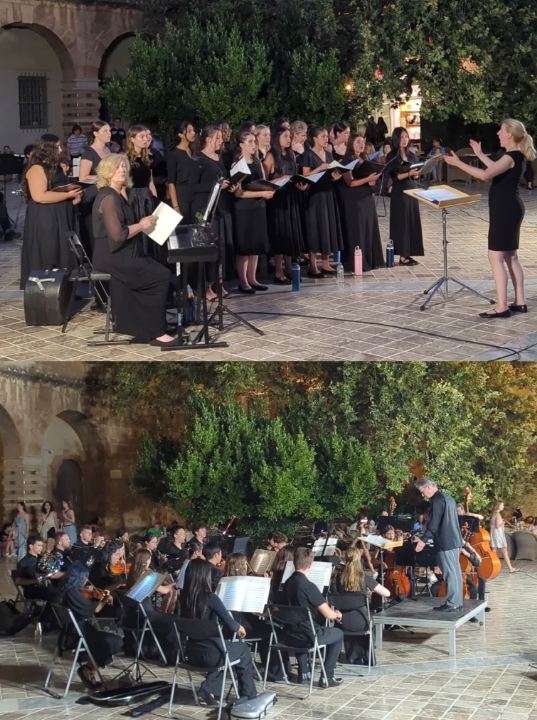
Before we knew it, it was time to get ready for our first ever concert in Greece. It was going to be in the Syntagma Square of Nafplio, making it an unforgettable venue for our first concert. As we stepped off the bus, a few raindrops landed on our heads, and for a moment we thought the concert might be canceled. Thankfully, the rain never came, and we made it through the entire performance completely dry. What surprised me the most was seeing how many people were willing to just stop and listen. Locals and visitors gathered in the square, and seeing them enjoy music reminded me of how music is truly a universal language. The audience especially loved Five Greek Dances and Zorba’s Suite, two pieces recommended to MYO by the Underground Youth Orchestra from Athens. Watching everyone clap along and smile during those songs made it clear how much music meant to the Greek people. It was such a rewarding feeling to share something we had worked so hard at with an audience that truly appreciated it, and it’s a memory I’ll never forget.