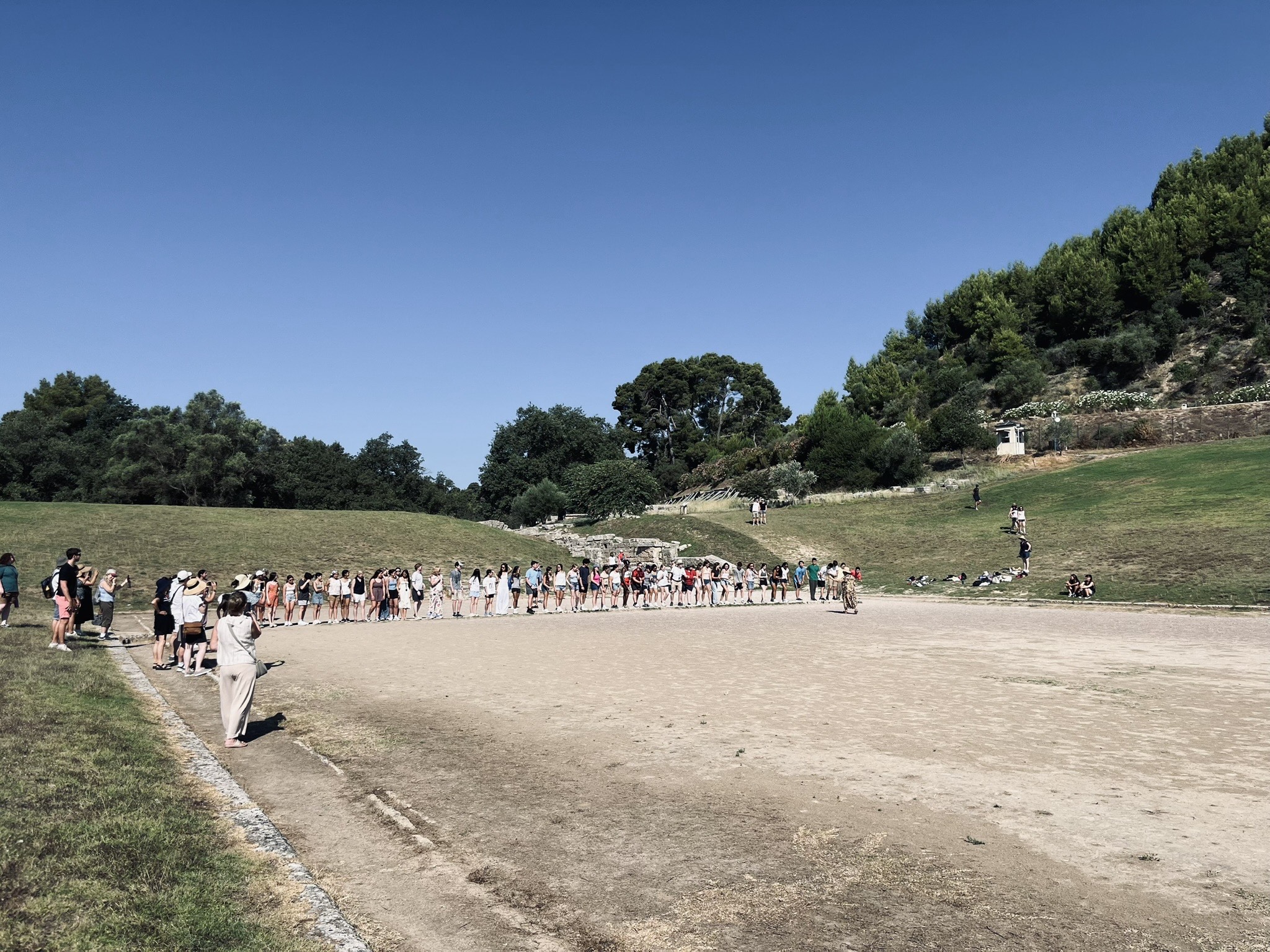
Kalimera! Our day started at 7am, we boarded our bus once again, but this time to the ancient archaeological site of Olympia. If the name Olympia sounds familiar, you’re probably thinking of the Olympic Games, and you’d be exactly right. Olympia is the birthplace of the original Olympic Games, where ancient Greek athletes competed in honor of Zeus over 2,700 years ago. Half an hour later, we arrived at the site and began our tour of the ancient gymnasium. There, Eleni brought history to life by walking us through the rigorous training process an Olympic wrestling athlete would have endured, using one of our trumpet players, Joe, as a volunteer. After that, we headed over to the ancient stadium, which Eleni explained was the distance competitors would race in one of the original Olympic events. Now, it was time for us to line up at the ancient starting lines and race like true Olympians. As I sprinted down the track, I couldn’t help but wonder if athletes more than 2,700 years ago felt the same rush as excitement when competing. We gave it our all, and when the race was over, our horn player, “Brettos” (Eleni’s Greek name for Brett), crossed the finish line first and claimed the victory.
After our exhilarating competition, we walked over to the museum to check out some of the artifacts found in the ruins we just visited. We took a look at some of the armor that Greek warriors wore, which gave Eleni the opportunity to give an interactive demonstration of how battles were fought. From there, we admired towering statues that illustrated famous myths, each with its own fascinating story. One sculpture that caught my attention was one that depicted the Centauromachy, the legendary battle between the Greeks and the half-man, half-horse centaurs. The scene was incredibly detailed and full of movement, capturing the chaos of the conflict while symbolizing the triumph of civilization and order over disorder. Admittedly, museums don’t usually hold my attention for very long, and I’m often trying not to doze off. However, Eleni’s storytelling turned the statues in the room into ancient Greek life, making it quite an engaging experience.
When we were finished strolling through the museum, we had a quick break and boarded the bus again on our way to Itea. Along the way to Itea, we eventually reached the Rio-Antirrio Bridge. Stretching across the Gulf of Corinth, the massive bridge connects Greece to the Peloponnese. From the bus, the towers looked enormous as they rose out of the water, and the bridge seemed to go on forever. The views were amazing, and it definitely made the long drive to Itea more interesting. For lunch we stopped at Nafpaktos, a historic seaside town on the northern shore of the Gulf of Corinth, known for its picturesque Venetian harbor and medieval castle. My friends and I found a restaurant overlooking the water, where I had a great view of the castle’s stone fortifications stretching into the water. Built by the Venetians to defend the harbor, the castle serves as a reminder of Nafpaktos’ long history as an important naval stronghold. Our home for the next three nights was the Nafsika Palace Hotel, located in the heart of Itea. Itea is a modern port town that serves as the gateway to Delphi, one of Greece’s most famous archeological sites. After settling in, we enjoyed dinner at the hotel before spending the evening strolling along Itea’s waterfront promenade. The sea breeze, bustling cafes, and a scoop of Greek gelato in hand was the perfect combination to unwind before our visit to Delphi the following day.