Welcome back! Today was definitely a day I was looking forward to, because we were going to be visiting Meteora!
As we twisted and turned up onto the rock formations above, Eleni told us about the history of these monasteries perched up in the clouds. The monasteries were built during the 14th and 16th centuries, a time when much of Greece was experiencing political unrest and frequent invasions. Seeking safety and solitude, Eastern Orthodox monks constructed their monasteries atop the region’s towering sandstone pillars, where the cliffs provided both protection from conflict and a quiet environment they desired for prayer and worship. Looking up at the monasteries, their existence almost seemed impossible; how did they even get up there back then? It turns out, they used rope ladders that could be pulled up after someone climbed them. Thankfully, we weren’t going to be using those. Instead, we had to climb what felt like thousands of stairs up to the monasteries. Trekking up those stairs in a long skirt definitely wasn’t easy, so I was hoping the monasteries would be absolutely breathtaking.
Catching my breath at the top of the stairs, I was amazed at the fairytale-like entrance of the monastery. As I made my way into the first monastery, I spotted another cat settled on one of the stair railings. I was confused because I thought that a cat would actually climb its way more than a thousand feet in the air. However, cats are actually used as pest-controllers in monasteries. Monasteries usually store large amounts of food in cellars and storerooms, so cats can help hunt mice and rats to protect food supplies from being destroyed.
As we squeezed our ways through the narrow passageways leading to the monastery, I couldn’t help but wonder how people managed to build such an incredible structure on top of a cliff centuries before modern machinery. Stepping inside the monastery felt like entering a completely different world. Every wall and ceiling was covered in vibrant Byzantine frescoes depicting scenes from the Bible, with rich colors and intricate details that had survived for centuries. I found myself looking in every direction as Eleni explained the stories behind each detailed fresco, because there was something beautiful to admire everywhere. However, not all the frescoes were peaceful or uplifting. Many depicted scenes of martyrdom, suffering, and death in vivid detail. These paintings were meant to remind monks and visitors of mortality, judgment, sacrifice, and the consequences of sin. Most of the rooms followed a similar layout, with a portrait of Jesus Christ at the highest point of the ceiling and saints surrounding the walls below. The visuals inside were truly stunning, and it was nothing like walking through a museum. Each painting wasn’t just for decoration, they each served a specific purpose in an active place of worship.
After visiting the first monastery and taking a group picture, we had a few minutes to check out the view and explore other parts of the monastery. From where I was standing, the town of Kalambaka seemed tiny. Standing there, I could understand why the monks chose this place, because it felt completely detached from the rest of the world. I then decided to check out the small museums that were also part of the monasteries. Inside were collections of religious icons, handwritten manuscripts, and ceremonial robes that offered a glimpse into what life was like for the monks who lived there. Seeing those artifacts made the history of Meteora feel much more real.
After we were done exploring the monasteries, we headed back to Kalambaka for lunch. We ended up in the same part of town as the day before, but there was still plenty left to explore. As we walked around, I spotted a public library and decided to check it out. It looked pretty much like any other library, except almost every book on the shelves was in Greek. Even though I couldn’t read most of them, it was still fun to look around. The librarians were incredibly friendly and even offered to feature us in one of the library’s social media posts, which was a fun and unexpected surprise. It was one of those random little moments that made exploring the town even more memorable.
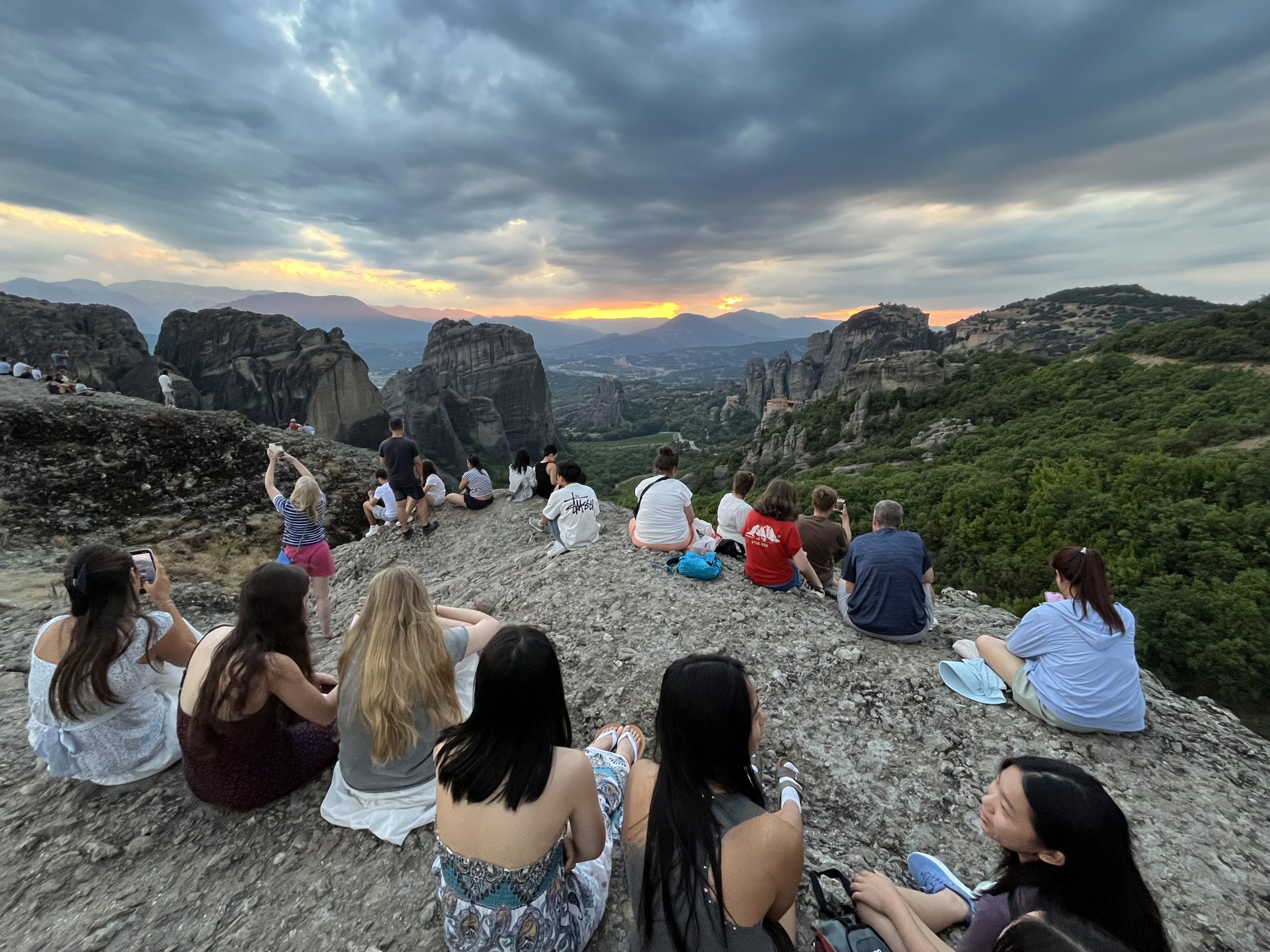
After dinner, we climbed back onto the bus for one last stop before calling it a night. Eleni had promised that Meteora looked even more spectacular at sunset, and she was right. We pulled over at a scenic overlook just as the sun began to sink behind the mountains, giving us plenty of time to take photos and simply enjoy the view. As the sky slowly shifted colors from blue to shades of orange, pink, and purple, the towering sandstone pillars took on an entirely different appearance. The warm light illuminating behind the mountains made them seem as though they were glowing against the cliffs. Near the bus, Eleni offered us orange soda and other refreshments. The orange soda was one of the best sodas I’ve ever had, and enjoying it with one of the most memorable sunsets I have ever seen was the perfect way to end the day.